Wilderness First Aid Guide: Handling Outdoor Emergencies
Wilderness First Aid is different from first aid at home or school. When a hospital is hours or days away, you need to know how to keep an injured person safe, warm, and stable while your patrol arranges for help.
Checking the Scene and the Patient
Before rushing in to help an injured person, stop and look around. Rescuer safety always comes first.
The S.T.O.P. Rule
- S – Stop: Take a deep breath. Stay calm.
- T – Think: Check for danger (falling rocks, lightning, swift water, traffic).
- O – Observe: See how many people are hurt and what supplies you have.
- P – Plan: Put on medical gloves, make a plan, and assign jobs to your patrol.
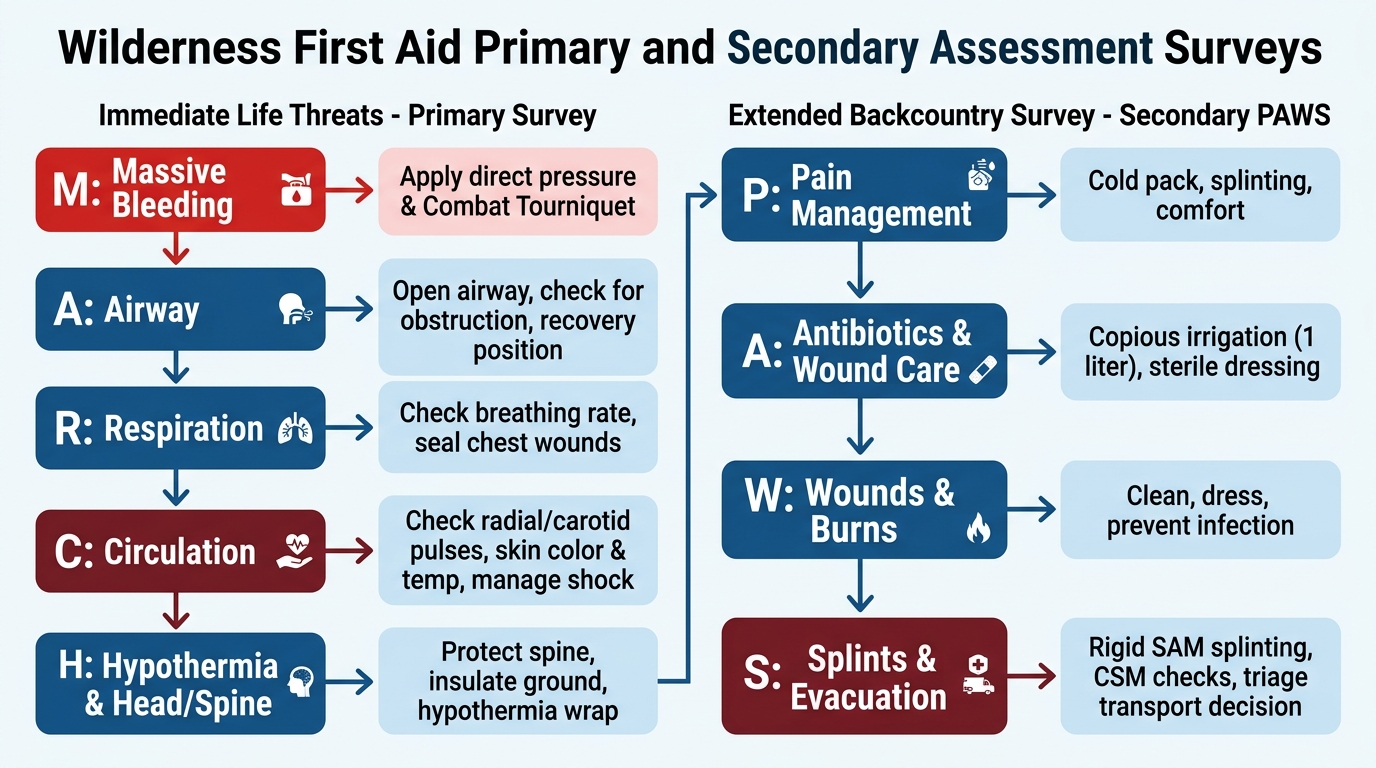
The Primary Check: The MARCH Protocol
In the outdoors, severe bleeding is the fastest threat to life. Follow the MARCH steps for your quick 60-second check:
| Letter | What to Check | What to Look For | What to Do Right Away |
|---|---|---|---|
| M – Massive Bleeding | Arms, legs, neck, and body | Spurting or pooling blood | Press hard on the wound with clean gauze or use a commercial tourniquet. |
| A – Airway & Neck | Throat and breathing passage | Blocked throat; neck injuries | Keep the head still; open airway using the jaw-thrust without bending the neck. |
| R – Respiration (Breathing) | Chest rise and breath sounds | Trouble breathing; chest wounds | Cover open chest holes with a vented chest seal; sit patient comfortably. |
| C – Circulation | Wrist and neck pulse | Weak pulse; cold, pale skin | Check wrist pulse and nailbed color; keep patient lying flat to treat shock. |
| H – Hypothermia & Head | Body warmth and alertness | Shivering, confusion, cold ground | Put an insulated sleeping pad and sleeping bag under the patient right away! |
M – Massive Bleeding
- What to Check
- Arms, legs, neck, and body
- What to Look For
- Spurting or pooling blood
- What to Do Right Away
- Press hard on the wound with clean gauze or use a commercial tourniquet.
A – Airway & Neck
- What to Check
- Throat and breathing passage
- What to Look For
- Blocked throat; neck injuries
- What to Do Right Away
- Keep the head still; open airway using the jaw-thrust without bending the neck.
R – Respiration (Breathing)
- What to Check
- Chest rise and breath sounds
- What to Look For
- Trouble breathing; chest wounds
- What to Do Right Away
- Cover open chest holes with a vented chest seal; sit patient comfortably.
C – Circulation
- What to Check
- Wrist and neck pulse
- What to Look For
- Weak pulse; cold, pale skin
- What to Do Right Away
- Check wrist pulse and nailbed color; keep patient lying flat to treat shock.
H – Hypothermia & Head
- What to Check
- Body warmth and alertness
- What to Look For
- Shivering, confusion, cold ground
- What to Do Right Away
- Put an insulated sleeping pad and sleeping bag under the patient right away!
When and How to Evacuate
| Situation Level | How Fast to Evacuate | Examples | What Your Patrol Does |
|---|---|---|---|
| Emergency (Life-Threatening) | Right away / Call Search & Rescue | Severe bleeding, core body temp below 90°F or above 104°F, unconsciousness, severe chest pain | Press SOS on satellite messenger or call 911; clear a helicopter landing zone |
| Urgent (Within 6–12 Hours) | Same-day evacuation | Broken bones that are splinted, deep wounds needing stitches, severe sprains | Carry patient in a litter or coordinate with Search & Rescue ground teams |
| Non-Urgent (Walk Out) | Hike out when ready | Minor sprains, small scrapes, mild altitude headache, mild asthma | Patrol carries patient’s pack and walks out with them to the trailhead |
Emergency (Life-Threatening)
- How Fast to Evacuate
- Right away / Call Search & Rescue
- Examples
- Severe bleeding, core body temp below 90°F or above 104°F, unconsciousness, severe chest pain
- What Your Patrol Does
- Press SOS on satellite messenger or call 911; clear a helicopter landing zone
Urgent (Within 6–12 Hours)
- How Fast to Evacuate
- Same-day evacuation
- Examples
- Broken bones that are splinted, deep wounds needing stitches, severe sprains
- What Your Patrol Does
- Carry patient in a litter or coordinate with Search & Rescue ground teams
Non-Urgent (Walk Out)
- How Fast to Evacuate
- Hike out when ready
- Examples
- Minor sprains, small scrapes, mild altitude headache, mild asthma
- What Your Patrol Does
- Patrol carries patient’s pack and walks out with them to the trailhead
Ways to Call for Help in the Backcountry
| Method | How It Works | Signal Needed | Best Way to Use It |
|---|---|---|---|
| Cell Phone / SMS | Cell towers (Voice/Text) | Low cell service | If calls drop, send a text to 911 (text messages can send through tiny bursts of signal). |
| Satellite Messenger | InReach, ZOLEO, Apple SOS | Clear view of sky | Send your GPS coordinates, patient age, injuries, and what help you need. |
| Personal Locator Beacon | Emergency NOAA Satellites | Direct distress beacon | Turn on ONLY in life-threatening emergencies where someone cannot survive without immediate rescue. |
| Ground-to-Air Signals | Visual signals on the ground | Aircraft search | Stamp out big 10-foot letters in snow: V (Need Help) or X (Medical Help), or make 3 whistle blasts. |
Cell Phone / SMS
- How It Works
- Cell towers (Voice/Text)
- Signal Needed
- Low cell service
- Best Way to Use It
- If calls drop, send a text to 911 (text messages can send through tiny bursts of signal).
Satellite Messenger
- How It Works
- InReach, ZOLEO, Apple SOS
- Signal Needed
- Clear view of sky
- Best Way to Use It
- Send your GPS coordinates, patient age, injuries, and what help you need.
Personal Locator Beacon
- How It Works
- Emergency NOAA Satellites
- Signal Needed
- Direct distress beacon
- Best Way to Use It
- Turn on ONLY in life-threatening emergencies where someone cannot survive without immediate rescue.
Ground-to-Air Signals
- How It Works
- Visual signals on the ground
- Signal Needed
- Aircraft search
- Best Way to Use It
- Stamp out big 10-foot letters in snow:
V(Need Help) orX(Medical Help), or make 3 whistle blasts.
Taking Notes on the Patient (SOAP Note)
A SOAP note helps you organize your notes and give clean information to paramedics or Search & Rescue teams:
| SOAP Section | What It Means | What You Write Down |
|---|---|---|
| S – Subjective | The Patient’s Story | Name, age, time of injury, where it hurts, and SAMPLE notes (Signs, Allergies, Medications, Past medical issues, Last food/water, Events leading up). |
| O – Objective | What You Find | Findings from your head-to-toe check (DOTS: Deformities, Open wounds, Tenderness, Swelling) and vital signs (Time, Pulse rate, Breathing rate, Skin warmth). |
| A – Assessment | Problem List | List the problems in order of danger (e.g. 1: Broken lower leg; 2: Mild hypothermia; 3: Scraped elbow). |
| P – Plan | What You Did | Treatments you gave (splinting, bandages, warm wrap), how you plan to evacuate, and when to re-check vitals. |
S – Subjective
- What It Means
- The Patient’s Story
- What You Write Down
- Name, age, time of injury, where it hurts, and SAMPLE notes (Signs, Allergies, Medications, Past medical issues, Last food/water, Events leading up).
O – Objective
- What It Means
- What You Find
- What You Write Down
- Findings from your head-to-toe check (DOTS: Deformities, Open wounds, Tenderness, Swelling) and vital signs (Time, Pulse rate, Breathing rate, Skin warmth).
A – Assessment
- What It Means
- Problem List
- What You Write Down
- List the problems in order of danger (e.g. 1: Broken lower leg; 2: Mild hypothermia; 3: Scraped elbow).
P – Plan
- What It Means
- What You Did
- What You Write Down
- Treatments you gave (splinting, bandages, warm wrap), how you plan to evacuate, and when to re-check vitals.
How Awake Is the Patient? (The AVPU Scale)
| Score | How the Patient Responds | How to Check |
|---|---|---|
| A – Alert | Wide awake; knows who they are, where they are, and what time it is | Ask simple questions: “What is your name? Where are we?” |
| V – Verbal | Drowsy; opens eyes or speaks only when you talk loudly | Speak loudly near their ear |
| P – Pain | Responds only to pinch or rub; does not speak | Gently pinch the shoulder muscle |
| U – Unresponsive | Completely unconscious; does not respond to voice or touch | Check breathing and neck pulse immediately |
A – Alert
- How the Patient Responds
- Wide awake; knows who they are, where they are, and what time it is
- How to Check
- Ask simple questions: “What is your name? Where are we?”
V – Verbal
- How the Patient Responds
- Drowsy; opens eyes or speaks only when you talk loudly
- How to Check
- Speak loudly near their ear
P – Pain
- How the Patient Responds
- Responds only to pinch or rub; does not speak
- How to Check
- Gently pinch the shoulder muscle
U – Unresponsive
- How the Patient Responds
- Completely unconscious; does not respond to voice or touch
- How to Check
- Check breathing and neck pulse immediately
Treating Injuries in the Field
Severe Bleeding & Tourniquets
If direct pressure with gauze pads cannot stop severe spurting bleeding on an arm or leg:
Broken Bones & Sprains: Checking CSMs
Always check CSMs before and after you put on any splint:
- C – Circulation (Blood Flow): Check for a pulse past the injury (wrist or foot). Make sure the fingers or toes feel warm.
- S – Sensation (Feeling): Have the patient close their eyes. Touch a toe or finger and ask: “Which toe am I touching?”
- M – Movement: Ask the patient to wiggle their fingers or toes.
| Splinting Step | What to Do |
|---|---|
| 1. Shape First | Splint the limb in the position you found it. |
| 2. Immobilize Joints | Support the joint above and the joint below the broken bone. |
| 3. Pad the Splint | Place soft clothing or fleece between the splint and the skin. |
| 4. Leave Toes/Fingers Out | Keep fingers or toes uncovered so you can re-check CSMs every 15 minutes. |
1. Shape First
- What to Do
- Splint the limb in the position you found it.
2. Immobilize Joints
- What to Do
- Support the joint above and the joint below the broken bone.
3. Pad the Splint
- What to Do
- Place soft clothing or fleece between the splint and the skin.
4. Leave Toes/Fingers Out
- What to Do
- Keep fingers or toes uncovered so you can re-check CSMs every 15 minutes.
Cold, Heat, and Altitude Emergencies
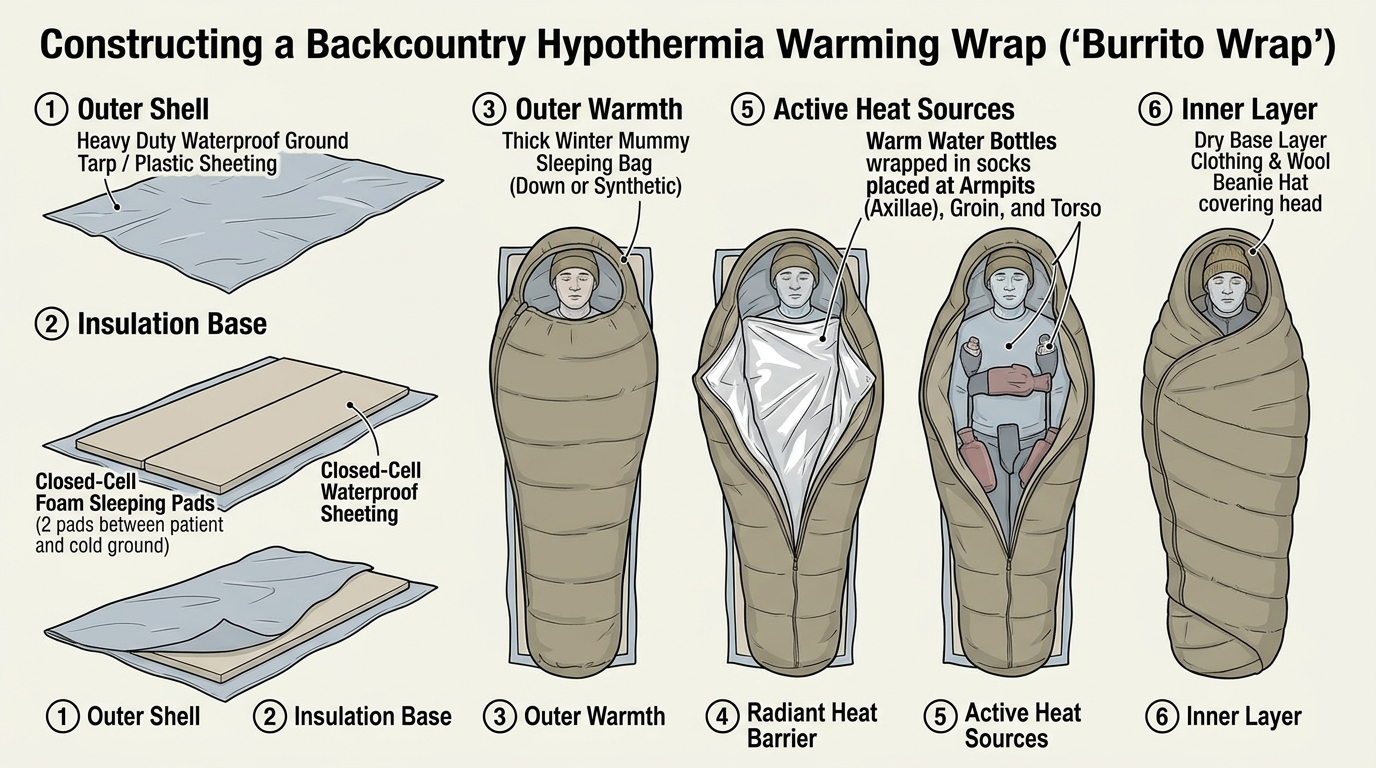
Hypothermia & The “Burrito Wrap”
Hypothermia happens when body temperature drops below 95°F.
| Level | Signs & Symptoms | What to Do |
|---|---|---|
| Mild Hypothermia | Shivering, feeling cold, “Umbles” (stumbling, mumbling, fumbling, grumbling) | Put on dry clothes, windproof jacket, drink warm sweet drinks, do gentle walking. |
| Moderate Hypothermia | Shivering stops, slurred speech, confusion, clumsy movements | Build a full Hypo Burrito Wrap, place warm bottles on chest/armpits, handle gently. |
| Severe Hypothermia | Unconscious, barely breathing, very weak pulse | Immediate Hypo Wrap, do not shake or move roughly, call Search & Rescue ASAP! |
Mild Hypothermia
- Signs & Symptoms
- Shivering, feeling cold, “Umbles” (stumbling, mumbling, fumbling, grumbling)
- What to Do
- Put on dry clothes, windproof jacket, drink warm sweet drinks, do gentle walking.
Moderate Hypothermia
- Signs & Symptoms
- Shivering stops, slurred speech, confusion, clumsy movements
- What to Do
- Build a full Hypo Burrito Wrap, place warm bottles on chest/armpits, handle gently.
Severe Hypothermia
- Signs & Symptoms
- Unconscious, barely breathing, very weak pulse
- What to Do
- Immediate Hypo Wrap, do not shake or move roughly, call Search & Rescue ASAP!
Heat Exhaustion vs. Heat Stroke
| Condition | Body Signs & Skin | How the Scout Acts | What You Must Do |
|---|---|---|---|
| Heat Exhaustion | Heavy sweating, pale cool clammy skin, headache | Normal thinking, tired, thirsty | Rest in shade, loosen clothes, sip cool water with electrolytes, fan with hat. |
| Heat Stroke (Emergency!) | Hot red skin, sweating may stop, very rapid pulse | Confused, dizzy, fainting, seizures | Cool First, Move Second! Douse with cold water, fan aggressively, place ice/cold packs on neck and armpits, call 911/SAR! |
Heat Exhaustion
- Body Signs & Skin
- Heavy sweating, pale cool clammy skin, headache
- How the Scout Acts
- Normal thinking, tired, thirsty
- What You Must Do
- Rest in shade, loosen clothes, sip cool water with electrolytes, fan with hat.
Heat Stroke (Emergency!)
- Body Signs & Skin
- Hot red skin, sweating may stop, very rapid pulse
- How the Scout Acts
- Confused, dizzy, fainting, seizures
- What You Must Do
- Cool First, Move Second! Douse with cold water, fan aggressively, place ice/cold packs on neck and armpits, call 911/SAR!
Altitude Sickness
When hiking above 8,000 feet, thinner air can cause altitude sickness:
- Mild Mountain Sickness: Headache, upset stomach, tiredness, trouble sleeping. Rest, drink plenty of water, and do not climb higher.
- Severe Mountain Sickness: Trouble breathing while resting, coughing, slurred speech, or unable to walk a straight line.
- The #1 Rule of Altitude Sickness: “GO DOWN!” Hiking down 1,000 to 2,000 feet is the fastest, safest cure.
Snake Bites (North American Pit Vipers)
- Keep the patient calm and sitting still (moving fast spreads venom).
- Take off rings, watches, and boots before swelling starts.
- Keep the bite at heart level (not elevated, not hanging down).
- Draw a circle around the swelling with a pen and write the time; check every 15 minutes.
- NEVER cut the bite, suck out venom, apply ice, or use a tourniquet.
- Get the patient to a hospital right away.
Patrol First Aid Kit Checklist
Patrol Wilderness First Aid Kit Checklist
Pack these items in your patrol first aid pouch
- 6 pairs of nitrile gloves (non-latex) and CPR face shield.
- 1 commercial tourniquet (CAT or SOFTT-W) and trauma shears.
- 2 pressure bandages and 10 sterile gauze pads.
- 1 SAM Splint (36-inch) and 2 triangular bandages (cravats).
- 1 roll of elastic athletic wrap (Ace bandage) and medical tape.
- Blister moleskin, hydrocolloid pads, and assorted band-aids.
- Antiseptic wipes, clean water flush syringe, and triple antibiotic ointment.
- Waterproof notebook and pencil for SOAP notes.
- Tick tweezers and digital thermometer.
- Emergency space blanket or thermal bivvy.