Camp Cooking & Kitchen Guide: Stoves, Dutch Ovens & Clean-Up
Great camp cooking is the engine of high patrol morale. A well-run patrol kitchen operates cleanly, safely, and efficiently, producing nutritious, high-calorie meals while upholding strict sanitation standards and Leave No Trace principles.
Patrol Kitchen Layout & Food Safety
A campsite kitchen must be organized systematically to prevent foodborne illness, avoid cross-contamination, and protect food from wildlife.
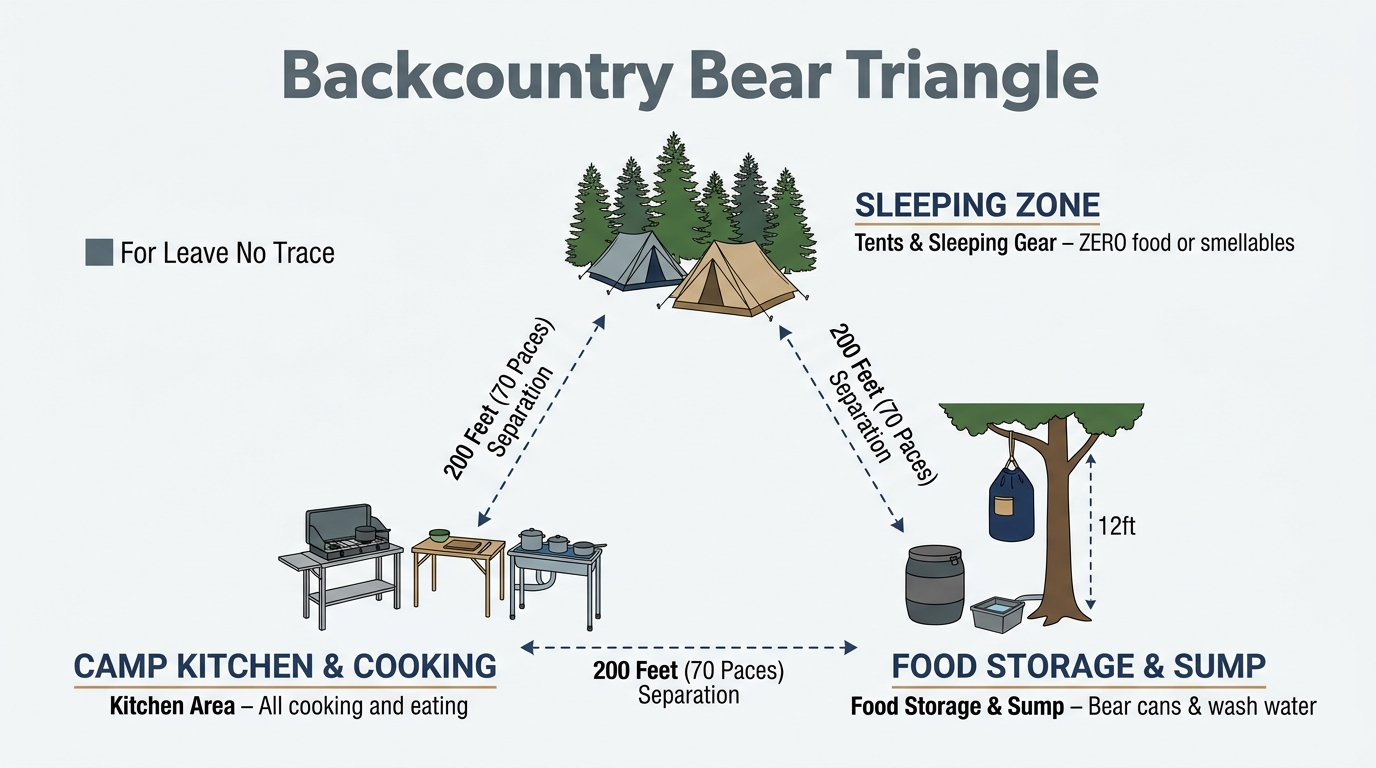
The 200-Foot Bear Triangle Rule
In bear and critter territory, establish three distinct areas separated by at least 200 feet (70 paces) in a triangular layout:
- Sleeping Area: Tents must contain zero food, scented toiletries, wrappers, or clothes worn while cooking (“smellables”).
- Kitchen & Cooking Area: Downwind from the sleeping area. All cooking, prepping, and dishwashing occurs here.
- Food Storage & Gray Water Sump: Bear-resistant canisters, Ursacks, or counterbalance PCT bear hangs suspended 12 feet high and 6 feet out from tree trunks.
Food Safety Temperatures & Cooler Management
| Food Category | Safe Internal Cooking Temp | Target Holding Temp |
|---|---|---|
| Poultry (Chicken, Turkey) | 165°F (74°C) | Hot: > 140°F (60°C) |
| Ground Meats (Beef, Pork) | 160°F (71°C) | Hot: > 140°F (60°C) |
| Whole Cuts (Steak, Chops, Fish) | 145°F (63°C) (with 3-min rest) | Hot: > 140°F (60°C) |
| Reheated Leftovers / Soups | 165°F (74°C) (rolling boil) | Hot: > 140°F (60°C) |
| Cold Food Storage (Coolers) | Cold: < 40°F (4°C) | Ice submerged |
Poultry (Chicken, Turkey)
- Safe Internal Cooking Temp
- 165°F (74°C)
- Target Holding Temp
- Hot: > 140°F (60°C)
Ground Meats (Beef, Pork)
- Safe Internal Cooking Temp
- 160°F (71°C)
- Target Holding Temp
- Hot: > 140°F (60°C)
Whole Cuts (Steak, Chops, Fish)
- Safe Internal Cooking Temp
- 145°F (63°C) (with 3-min rest)
- Target Holding Temp
- Hot: > 140°F (60°C)
Reheated Leftovers / Soups
- Safe Internal Cooking Temp
- 165°F (74°C) (rolling boil)
- Target Holding Temp
- Hot: > 140°F (60°C)
Cold Food Storage (Coolers)
- Safe Internal Cooking Temp
- Cold: < 40°F (4°C)
- Target Holding Temp
- Ice submerged
Patrol Cooler Management Rules
- Block Ice vs. Cubed Ice: Use frozen solid 1-gallon water jugs or commercial block ice. Block ice lasts 3 to 4 times longer than crushed cubed ice.
- Pre-Chill Everything: Chill both the cooler and all food items in a home refrigerator 24 hours prior to packing.
- Layering Order: Place block ice on the bottom, raw meat double-sealed in heavy-duty zip bags directly on the ice, dairy and vegetables in the middle, and delicate items (bread, eggs) in elevated dry racks on top.
- Do Not Drain Meltwater Continuously (Unless Submerging Open Bags): Cold meltwater insulates the remaining ice better than warm ambient air.
The 3-Pot Dishwashing Sanitation System
Proper dishwashing in the field prevents gastrointestinal illnesses (such as Norovirus or Campylobacter) that can ruin a campout.
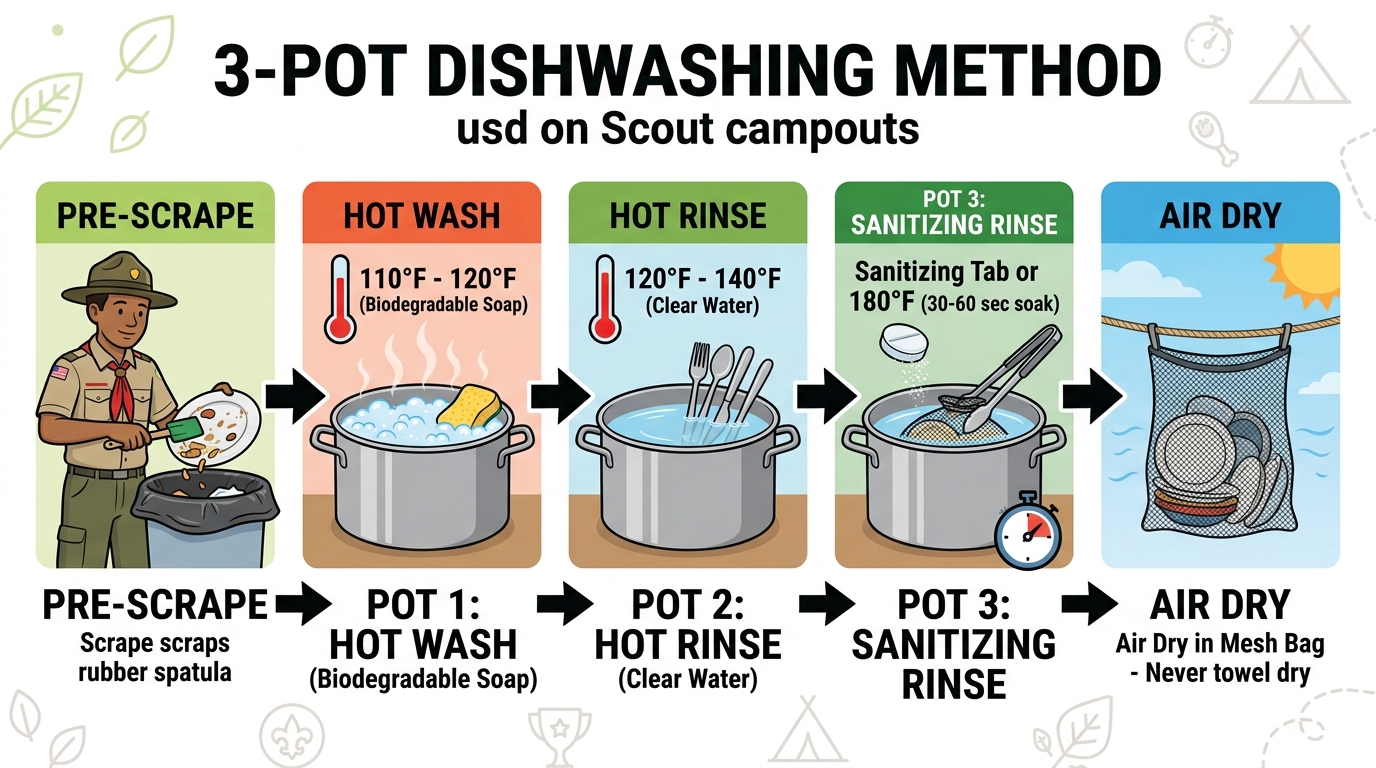
Step-by-Step Execution
- Pre-Scrape (“The Clean Plate Club”):
- Each Scout uses a silicone/rubber spatula to scrape every food scrap from their personal mess kit into the trash bag.
- Mess kits should be wiped nearly clean with a napkin before touching water.
- Pot 1 – Hot Wash:
- Temperature: 110°F – 120°F (comfortable to gloved hands).
- Add a few drops of concentrated biodegradable soap (e.g., CampSuds). Use an abrasive nylon scrub pad to wash plates, cups, and utensils.
- Pot 2 – Hot Clear Rinse:
- Temperature: 120°F – 140°F (hotter than wash water).
- Dip items into clean water to completely rinse away all residual soap film.
- Pot 3 – Sanitizing Rinse:
- Method A (Chemical Sanitizer): Warm water with 1 capful of unscented household bleach per gallon (or 1 commercial chlorine/quaternary sanitizing tablet per gallon). Submerge items for at least 60 seconds.
- Method B (Heat Sanitizer): Maintain rolling water temperature > 180°F (82°C). Submerge items using metal tongs or a wire dunking basket for at least 30 seconds.
- Air Drying:
- Place sanitized dishes into a ventilated mesh dunk bag.
- Hang the bag from a clothesline in the sun and wind.
- Never dry dishes with a dish towel, which transfers bacteria from plate to plate.
Sump & Gray Water Disposal
- Pour the water from Pot 1 and Pot 2 through a fine wire mesh strainer (sump screen) into Pot 3 to catch all suspended food particulates.
- Dump the trapped food solids into the garbage bag.
- Disposal Options:
- Broadcast Method (Leave No Trace standard): Walk at least 200 feet away from campsites, trails, and natural water bodies. Swing the bucket in a wide arc to fling the gray water into a fine mist over durable soil, rocks, or brush.
- Sump Hole Method (Established high-use camps): Pour gray water directly into a designated camp sump tube or a 1-foot-deep hole dug in mineral soil 200 feet from water.
Dutch Oven Mastery & Charcoal Calculator
A standard cast iron Dutch oven is an outdoor convection oven. The flanged lid holds burning charcoal briquettes, allowing top and bottom heat distribution for roasting, simmering, frying, and baking.
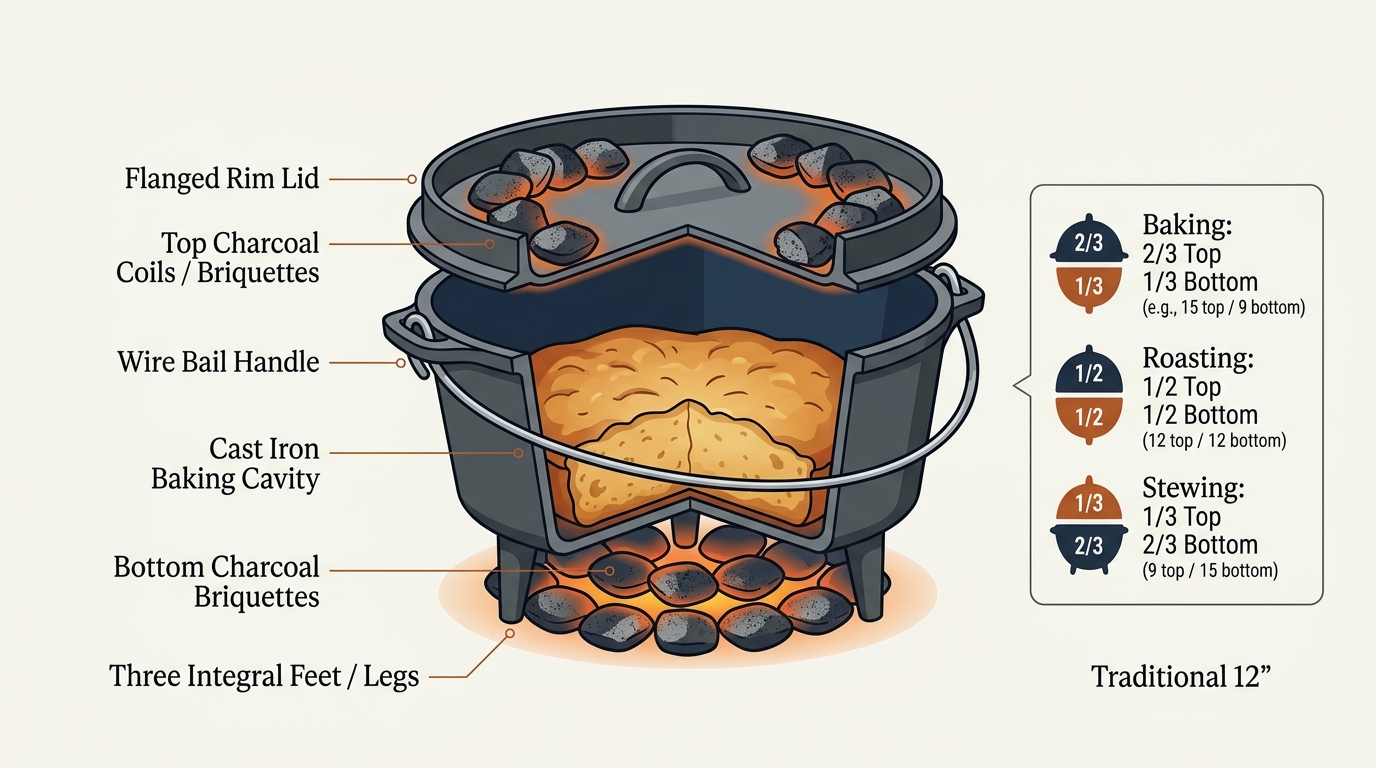
Sizing & Capacity Guide
| Oven Size | Liquid Capacity | Feeds (People) | Ideal For |
|---|---|---|---|
| 8-Inch | 2 Quarts | 2 – 4 | Side dishes, hot dips, patrol leader snacks |
| 10-Inch | 4 Quarts | 4 – 7 | Small patrol cobblers, breakfast casseroles, breads |
| 12-Inch Regular | 6 Quarts | 8 – 12 | Standard patrol main dishes, stews, 12" cakes |
| 12-Inch Deep | 8 Quarts | 10 – 14 | Whole chickens, large roasts, deep stews |
| 14-Inch Regular | 10 Quarts | 14 – 20 | Multi-patrol feasts, large roasts, whole turkeys |
8-Inch
- Liquid Capacity
- 2 Quarts
- Feeds (People)
- 2 – 4
- Ideal For
- Side dishes, hot dips, patrol leader snacks
10-Inch
- Liquid Capacity
- 4 Quarts
- Feeds (People)
- 4 – 7
- Ideal For
- Small patrol cobblers, breakfast casseroles, breads
12-Inch Regular
- Liquid Capacity
- 6 Quarts
- Feeds (People)
- 8 – 12
- Ideal For
- Standard patrol main dishes, stews, 12" cakes
12-Inch Deep
- Liquid Capacity
- 8 Quarts
- Feeds (People)
- 10 – 14
- Ideal For
- Whole chickens, large roasts, deep stews
14-Inch Regular
- Liquid Capacity
- 10 Quarts
- Feeds (People)
- 14 – 20
- Ideal For
- Multi-patrol feasts, large roasts, whole turkeys
The Charcoal Rule of Thumb & Cooking Modes
- The Fundamental Formula: Total Briquettes = $2 \times \text{Diameter of the Oven (in inches)}$
- Example: A 12-inch Dutch oven requires $2 \times 12 = 24$ total briquettes for a standard $350^\circ\text{F}$ bake.
| Cooking Mode | Primary Dishes | Heat Ratio (Top / Bottom) | Rule-of-Thumb Formula | 12-Inch @ 350°F Example |
|---|---|---|---|---|
| Baking | Breads, Cakes, Cobblers, Biscuits | 2/3 on Lid (Top), 1/3 on Bottom | Top = $D + 3$ | Bottom = $D - 3$ | 15 on Top, 9 on Bottom |
| Roasting | Whole Chicken, Beef Roast, Pork Loin | 1/2 on Lid (Top), 1/2 on Bottom | Top = $D$ | Bottom = $D$ | 12 on Top, 12 on Bottom |
| Stewing / Simmering | Chili, Soups, Gumbo, Beans | 1/3 on Lid (Top), 2/3 on Bottom | Top = $D - 3$ | Bottom = $D + 3$ | 9 on Top, 15 on Bottom |
| Frying / Boiling | Pancakes, Bacon, Pasta Water | 100% on Bottom (no coals on lid) | All coals under oven base | 24 on Bottom |
Baking
- Primary Dishes
- Breads, Cakes, Cobblers, Biscuits
- Heat Ratio (Top / Bottom)
- 2/3 on Lid (Top), 1/3 on Bottom
- Rule-of-Thumb Formula
- Top = $D + 3$ | Bottom = $D - 3$
- 12-Inch @ 350°F Example
- 15 on Top, 9 on Bottom
Roasting
- Primary Dishes
- Whole Chicken, Beef Roast, Pork Loin
- Heat Ratio (Top / Bottom)
- 1/2 on Lid (Top), 1/2 on Bottom
- Rule-of-Thumb Formula
- Top = $D$ | Bottom = $D$
- 12-Inch @ 350°F Example
- 12 on Top, 12 on Bottom
Stewing / Simmering
- Primary Dishes
- Chili, Soups, Gumbo, Beans
- Heat Ratio (Top / Bottom)
- 1/3 on Lid (Top), 2/3 on Bottom
- Rule-of-Thumb Formula
- Top = $D - 3$ | Bottom = $D + 3$
- 12-Inch @ 350°F Example
- 9 on Top, 15 on Bottom
Frying / Boiling
- Primary Dishes
- Pancakes, Bacon, Pasta Water
- Heat Ratio (Top / Bottom)
- 100% on Bottom (no coals on lid)
- Rule-of-Thumb Formula
- All coals under oven base
- 12-Inch @ 350°F Example
- 24 on Bottom
Complete Charcoal Heat Calculator Matrix
This table provides the exact briquette placement (Top / Bottom) for standard briquettes (e.g., Kingsford Original) at sea level under calm weather conditions.
| Oven Size | 325°F (163°C) | 350°F (177°C) | 375°F (191°C) | 400°F (204°F) | 425°F (218°C) | 450°F (232°C) |
|---|---|---|---|---|---|---|
| 8-Inch | 10 (7 top / 3 bot) | 12 (8 top / 4 bot) | 14 (9 top / 5 bot) | 16 (10 top / 6 bot) | 18 (11 top / 7 bot) | 20 (12 top / 8 bot) |
| 10-Inch | 14 (9 top / 5 bot) | 16 (11 top / 5 bot) | 18 (12 top / 6 bot) | 20 (13 top / 7 bot) | 22 (14 top / 8 bot) | 24 (16 top / 8 bot) |
| 12-Inch | 19 (12 top / 7 bot) | 21 (14 top / 7 bot) | 23 (15 top / 8 bot) | 25 (17 top / 8 bot) | 27 (18 top / 9 bot) | 29 (20 top / 9 bot) |
| 14-Inch | 24 (15 top / 9 bot) | 26 (17 top / 9 bot) | 28 (18 top / 10 bot) | 30 (20 top / 10 bot) | 32 (21 top / 11 bot) | 34 (23 top / 11 bot) |
| 16-Inch | 28 (18 top / 10 bot) | 30 (20 top / 10 bot) | 32 (21 top / 11 bot) | 34 (22 top / 12 bot) | 36 (24 top / 12 bot) | 38 (25 top / 13 bot) |
8-Inch
- 325°F (163°C)
- 10 (7 top / 3 bot)
- 350°F (177°C)
- 12 (8 top / 4 bot)
- 375°F (191°C)
- 14 (9 top / 5 bot)
- 400°F (204°F)
- 16 (10 top / 6 bot)
- 425°F (218°C)
- 18 (11 top / 7 bot)
- 450°F (232°C)
- 20 (12 top / 8 bot)
10-Inch
- 325°F (163°C)
- 14 (9 top / 5 bot)
- 350°F (177°C)
- 16 (11 top / 5 bot)
- 375°F (191°C)
- 18 (12 top / 6 bot)
- 400°F (204°F)
- 20 (13 top / 7 bot)
- 425°F (218°C)
- 22 (14 top / 8 bot)
- 450°F (232°C)
- 24 (16 top / 8 bot)
12-Inch
- 325°F (163°C)
- 19 (12 top / 7 bot)
- 350°F (177°C)
- 21 (14 top / 7 bot)
- 375°F (191°C)
- 23 (15 top / 8 bot)
- 400°F (204°F)
- 25 (17 top / 8 bot)
- 425°F (218°C)
- 27 (18 top / 9 bot)
- 450°F (232°C)
- 29 (20 top / 9 bot)
14-Inch
- 325°F (163°C)
- 24 (15 top / 9 bot)
- 350°F (177°C)
- 26 (17 top / 9 bot)
- 375°F (191°C)
- 28 (18 top / 10 bot)
- 400°F (204°F)
- 30 (20 top / 10 bot)
- 425°F (218°C)
- 32 (21 top / 11 bot)
- 450°F (232°C)
- 34 (23 top / 11 bot)
16-Inch
- 325°F (163°C)
- 28 (18 top / 10 bot)
- 350°F (177°C)
- 30 (20 top / 10 bot)
- 375°F (191°C)
- 32 (21 top / 11 bot)
- 400°F (204°F)
- 34 (22 top / 12 bot)
- 425°F (218°C)
- 36 (24 top / 12 bot)
- 450°F (232°C)
- 38 (25 top / 13 bot)
Weather & Altitude Adjustments
- High Wind: Wind strips heat rapidly. Add 2 to 4 briquettes to the top lid and surround the oven with a metal windscreen.
- Cold Ambient Temp (< 40°F / 4°C): Add 2 briquettes to the top and 2 to the bottom.
- High Altitude (> 5,000 ft): Liquid boils at lower temperatures and heat dissipates faster. Increase cooking time by 10–15% or add 2 briquettes.
Cast Iron Care & Seasoning Protocol
- Daily Cleaning in Camp:
- While the oven is still warm, pour in clean hot water.
- Scrub off residue using a wooden scraper, chainmail scrubber, or coarse kosher salt.
- NEVER use liquid dish soap or soak cast iron in water—soap penetrates the porous iron and strips the polymerized oil seasoning.
- Drying & Sanitizing:
- Place the cleaned oven over stove heat or hot coals for 2 minutes until all moisture evaporates completely.
- Re-Oiling:
- While hot, apply a pea-sized drop of high-smoke-point oil (canola, grapeseed, or Crisco) to the interior.
- Wipe with a clean paper towel until the iron looks matte and dry (never leave pooling liquid oil, which turns rancid).
- Storage:
- Place a folded paper towel or wooden clothespin between the lid and the pot to allow continuous airflow and prevent moisture condensation.
Backcountry Backpacking Stoves & Fuel Chemistry
| Stove Category | Fuel Type | Cold Weather Performance | Simmer Control | Pros | Cons |
|---|---|---|---|---|---|
| Canister (Upright) | Isobutane / Propane (80/20 mix) | Poor below 25°F (-4°C) | Outstanding | Ultralight (2–3 oz), instant ignition, clean | Non-refillable canisters; poor sub-freezing boil times |
| Inverted Canister | Isobutane / Propane | Good down to 10°F (-12°C) | Good | Stable low center of gravity; feeds liquid fuel | Slightly heavier than uprights |
| Liquid Fuel (White Gas) | Naphtha (Coleman Fuel) | Flawless to -40°F (-40°C) | Moderate to Poor | Extreme high BTU output; works at extreme altitude | Requires manual priming and pumping; heavier |
| Biomass / Twig Stove | Dry twigs, pinecones | Dependent on dry fuel | None | Infinite free fuel; ultralight | Banned during wildfire burn bans; soots pots |
Canister (Upright)
- Fuel Type
- Isobutane / Propane (80/20 mix)
- Cold Weather Performance
- Poor below 25°F (-4°C)
- Simmer Control
- Outstanding
- Pros
- Ultralight (2–3 oz), instant ignition, clean
- Cons
- Non-refillable canisters; poor sub-freezing boil times
Inverted Canister
- Fuel Type
- Isobutane / Propane
- Cold Weather Performance
- Good down to 10°F (-12°C)
- Simmer Control
- Good
- Pros
- Stable low center of gravity; feeds liquid fuel
- Cons
- Slightly heavier than uprights
Liquid Fuel (White Gas)
- Fuel Type
- Naphtha (Coleman Fuel)
- Cold Weather Performance
- Flawless to -40°F (-40°C)
- Simmer Control
- Moderate to Poor
- Pros
- Extreme high BTU output; works at extreme altitude
- Cons
- Requires manual priming and pumping; heavier
Biomass / Twig Stove
- Fuel Type
- Dry twigs, pinecones
- Cold Weather Performance
- Dependent on dry fuel
- Simmer Control
- None
- Pros
- Infinite free fuel; ultralight
- Cons
- Banned during wildfire burn bans; soots pots
Patrol Chuck Box Inventory Checklist
Standard equipment list for a patrol of 8 Scouts
- Cooking Hardware: 1 12-inch Cast Iron Dutch Oven with lid lifter and lid stand, 1 large 2-burner propane camp stove with regulator hose and propane tanks, 2 nesting aluminum stockpots (6 qt & 8 qt) with lids, 1 heavy-duty 12" non-stick skillet.
- Sanitation & 3-Pot Station: 3 large plastic or galvanized dishwashing tubs (labeled: Wash, Rinse, Sanitize), 1 bottle biodegradable camp soap, 1 bottle unscented chlorine bleach or sanitizing tablets, 2 nylon scrub pads, 2 fine mesh food sumps/strainers, 2 mesh dunk bags for air drying.
- Utensils & Prep: 2 high-density polyethylene cutting boards (color-coded: red for raw meats, green for vegetables), 2 chef knives with protective sheaths, 2 locking metal tongs, 2 large silicone spatulas, 2 long serving spoons, 1 stainless steel ladle, 1 digital instant-read food thermometer, 1 heavy-duty can opener.
- Safety & Protection: 1 ABC dry chemical fire extinguisher (2.5 lb), 2 pairs heavy-duty leather welding gloves (for hot Dutch ovens), 1 roll aluminum foil (heavy duty), 1 box 1-gallon heavy-duty freezer bags, 1 box 55-gallon contractor trash bags, 1 box nitrile gloves for food prep.
- Spice Kit & Condiments: Salt, black pepper, garlic powder, onion powder, paprika, cinnamon, cooking oil (canola/olive), non-stick cooking spray.